Broader Terms Curriculum Mapping: Using NLP and Visual Communication for Program Planning
- Surveys three types of curriculum mapping (outcome, concept, and broader-term), establishes "Knowledge Concepts" as the correct literature term, and reviews circular ideograms and network graphs as visualisation methods.
- Program Planning Experiences
- Accreditation bodies call for curriculum development processes open to all stake holders
- Students
- Industry
- University Faculty
- Society
- Collaboration potential is unexplored due to faculty interaction limitation
- Paper uses following
- Classification of learning objectives
- Natural language processing
- Data visualization
- Delivers quantitative method that delivers program plan representations
- Accreditation bodies call for curriculum development processes open to all stake holders
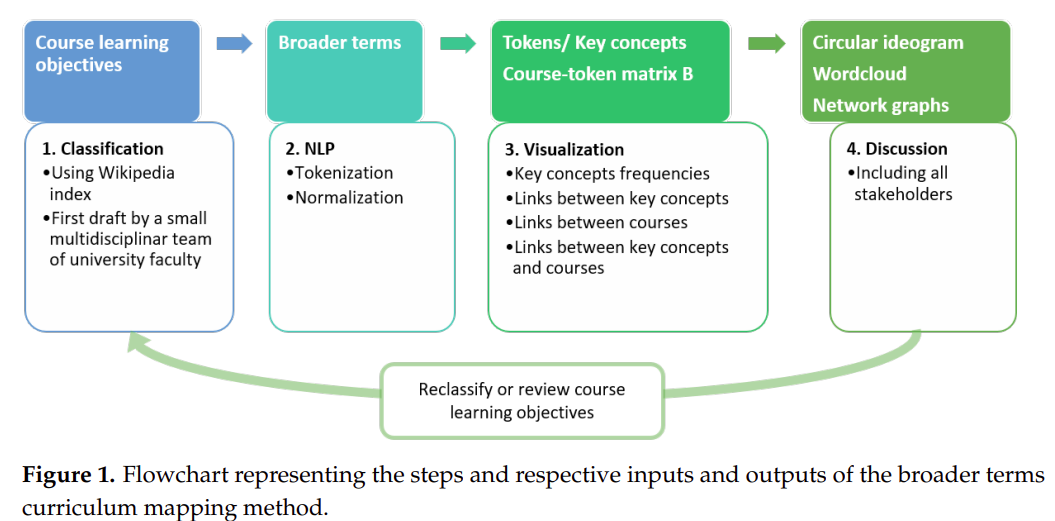
- Four steps
- Classification of course learning objective statements into broader terms
- Use of natural language processing (NLP) to convert broader terms into quantitative frequencies of key program concepts
- Visualization of key program concept frequencies and mapping with links between key concepts and or courses
- Discussion , considering the participation of all stakeholder groups, of method's visual outputs and decision to reclassify or review course learning objectives
- Table1 lists courses their learning objectives and the extracted broader terms
Relevance
- Validates chosen terminology "Knowledge Topics / Topic Overlap". This paper is where the term "Knowledge Concepts" is grounded — use it as literature reference when justifying the label change in your dashboard. Network graph + heatmap visualisations are cited here.